
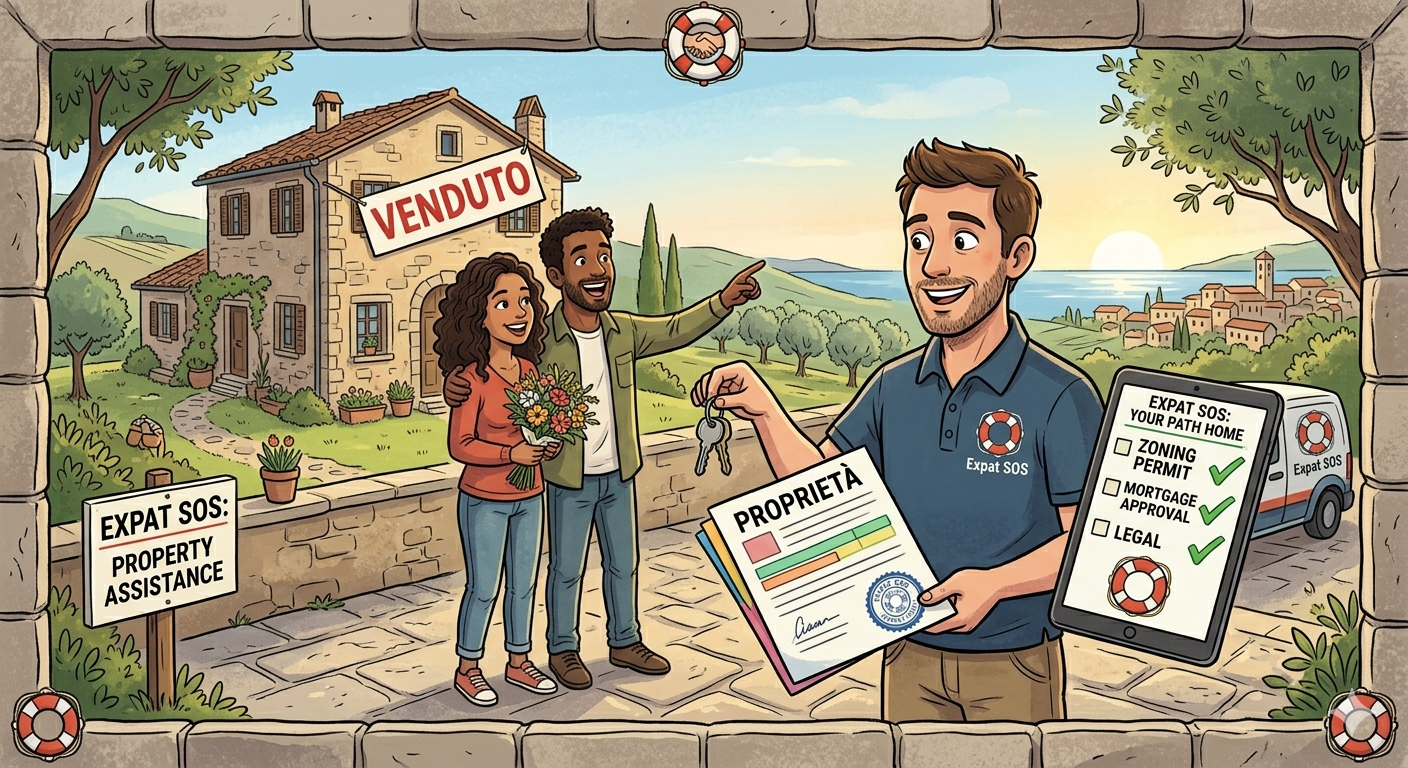
Visiting Italy often has the effect of the country growing on you, La dolce vita, culture the food and so on lead to many people asking theirselves “Can I actually buy a property in Italy?” Foreigners can freely buy property in Italy, provided their home country has a reciprocity agreement with Italy (allowing Italians to buy there). EU citizens and foreign residents with valid permits face no restrictions. Owning property does not automatically grant residency, but can strengthen long-stay visa applications.
In reality, buying a house was one of the easier things we’ve done here.
We bought a house in an ancient village, high on a hill near Lucca , like many it had been passed down by the family. There wasn’t even a floor plan for it.
This is where your geometra is really important, because they can check in communal archives to find the history of the building. It is common to find work done without planning permission, and also houses that have many owners.
I took someone to see a house once and it had 16 part owners! Needless to say, that house hasn’t been sold.
Another top tip is to call the real estate agents. We found it was rare for them to email back.
Stop asking ourself, can I actually buy a house in Italy? If you’re having problems with communicating, we’re here to help!
What you need to do
- Codice Fiscale: You must apply for an Italian tax code (Codice Fiscale) at a local Italian Consulate or online via the Agenzia delle Entrate to finalize any property transaction. This code is essential for life in Italy.
- Bank Account: Opening an Italian or international euro account is highly recommended for transferring funds.
- Property Search: Explore properties using localized real estate portals like Idealista, Immobiliare, or Subito. I highly recommend calling agents as opposed to emailing. Make an appointment to visit the property, if you are interested then contact a geometra to come with you on the next visit. ( we can put you in touch with our trusted geometra) On the subsequent visit, the geometra can take measurements and check everything with the local archives.
- Proposta d’Acquisto: Once you find a home, submit a binding written purchase proposal and pay a deposit (usually 1-3%). Your geometra can do
- Compromesso: Sign the preliminary contract, which outlines prices and conditions, and pay a larger deposit (10-30%).
- Rogito: The final deed of sale is signed before a public notary (Notaio), who registers the transaction and transfers ownership.
Key Professionals to hire.
- Notaio (Notary): Required by Italian law to verify the title, draft the final deed, and collect government taxes. You can find a licensed notary through the Consiglio Nazionale del Notariato directory.
- Geometra (Surveyor): Highly recommended to verify that the property’s physical boundaries match cadastral maps and that all renovations were legally permitted.
Taxes and Financials
- Registration Tax (Imposta di Registro): Varies based on residency. If you are buying a “first home” (primary residence) and moving to Italy, it is 2% of the cadastral value. For second homes, it rises to 9%. [1, 2]
- Mortgages: Non-resident foreigners can secure mortgages from Italian banks. Typically, banks limit the Loan-to-Value (LTV) to 50–60% and require a down payment of at least 40%.
If you need any help from form filling to translation services to help you through the process, we are here, contact us today, email: info@expatsos.it you can also message us through our Facebook page too!
