Moving to Italy as a non-EU national requires navigating a strict legal framework. Following Brexit, British citizens face these identical immigration hurdles.
Securing residency for non-EU nationals requires obtaining a specific long-stay visa before entering the country. Here is how moving to Italy as a non-EU national works.
Ultimate Guide to the Italian Type D Visa
Non-EU citizens cannot establish residency on a tourist waiver. If you plan to stay in Italy for more than 90 days, you must secure a Type D Visa (National Long-Stay Visa).
You must submit this application at the Italian consulate in your home country before moving. This visa serves as the mandatory foundation for legal residency for non-EU nationals (including Brits).
Top Italian Residency Pathways
To qualify for your entry visa, you must meet the criteria for one of these official categories:
1. Elective Residency Visa (ERV)
- Target Audience: Retirees and financially independent individuals.
- Requirements: Permanent passive income from pensions, properties, or investments.
- Restriction: You cannot hold a job or do freelance work in Italy.
Digital Nomad & Remote Work Visa
- Target Audience: Location-independent freelancers and corporate remote employees.
- Requirements: Proof of steady remote income exceeding the minimum threshold and valid work contracts.
Work Visas & EU Blue Card
- Target Audience: Sponsored employees and highly skilled professionals.
- Requirements: A formal job offer from an Italian company or specific freelance credentials.
Student Visa
- Target Audience: Individuals pursuing higher education or language courses.
- Requirements: Official enrollment confirmation from an accredited Italian university or school.
Investor Visa
- Target Audience: High-net-worth investors seeking fast-track residency.
- Requirements: Substantial capital investment in Italian businesses, startups, or government bonds.
How to Apply for the Permesso di Soggiorno: Step-by-Step
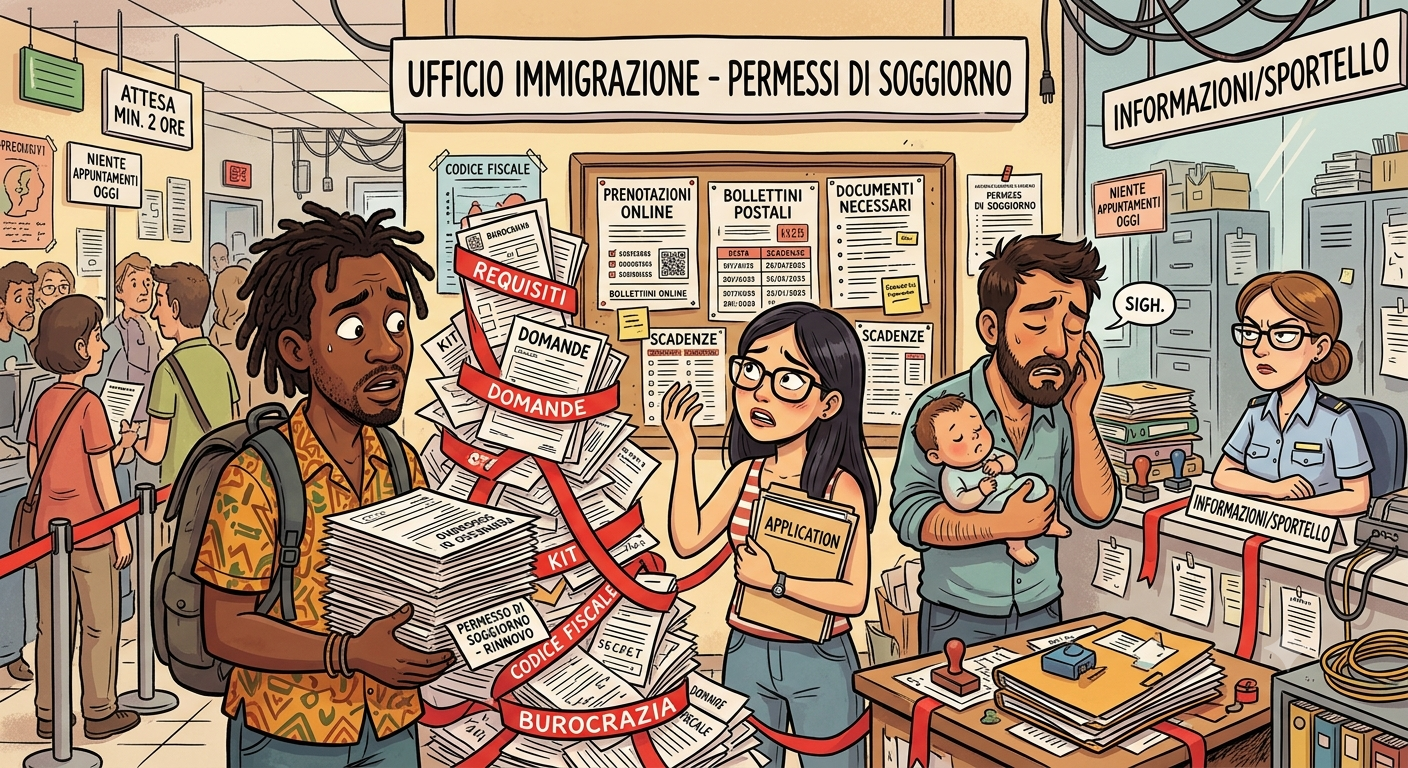
Securing your Type D visa is only the first half of the process. Moving to Italy as a non-EU national still requires you apply for a Permesso di Soggiorno (Permit of Stay) within 8 days of arriving in Italy.
Failing to meet this tight deadline can jeopardise your legal status. Here is exactly how to navigate the application process.
Step 1: Get the “Kit Giallo” (Yellow Kit)
- Go to a local Italian post office (Poste Italiane) that features a Sportello Amico counter. (A big central Post Office, not a small village branch)
- Request the Kit Giallo—a free envelope containing the necessary application forms (Modulo 1 and Modulo 2).
Step 2: Gather Your Required Documents
You must include photocopies of these documents inside your application kit:
- Passport pages: Copies of your main data page and the page showing your stamped Type D visa.
- Proof of accommodation: A registered Italian lease agreement (contratto de locazione) or a declaration of hospitality.
- Financial proof: The same economic documents used for your visa application.
- Health insurance: Proof of valid private coverage or registration with the Italian national health service (SSN).
- Marca da Bollo: A €16.00 official tax stamp purchased at any local tobacco shop (Tabaccheria).
Step 3: Submit the Kit at the Post Office
- Return the completed, unsealed envelope to a Sportello Amico post office.
- Pay the application and electronic card processing fees (approximately €100 to €150 depending on visa duration).
- Keep your receipt (Ricevuta): This slip functions as your temporary legal status. It allows you to stay in Italy while your application processes.
Step 4: Attend the Questura Appointment
- The post office will give you an appointment slip detailing a date and time to visit the local Immigration Office (Questura).
- At the Questura, immigration officials will take your fingerprints and verify your original documents.
- Once approved, you will receive an SMS text message to pick up your plastic, biometric Permesso di Soggiorno card.
And that’s it…nearly!
Then you need to register at your Comune for your residency, but I’ll talk about that in a separate post.
Contact us today, email: info@expatsos.it you can also message us through our Facebook page too!
